
Finding a free image used to be simple. Search Unsplash, download something tasteful, and move on with your life. Now there’s another question: Was this thing actually photographed?
AI-generated imagery is rapidly filling stock libraries, search results, social feeds, and asset marketplaces. That’s not necessarily bad—AI can be an incredibly useful design tool—but sometimes you want an actual photograph taken by an actual human. Or an illustration made with paint. Or a botanical drawing created by somebody who spent six hours staring at a leaf rather than six seconds writing a prompt.
And as generated images become increasingly polished, the little imperfections of real photography are starting to feel strangely luxurious. The good news is that the human-made web hasn’t disappeared yet. Far from it.

Here are 25 places designers can still find free photography, artwork, illustrations, historical imagery, textures, and other visual assets that can be used in commercial projects. Some are entirely focused on human-made work; others require you to pay attention to the individual asset and its license.
1. Unsplash
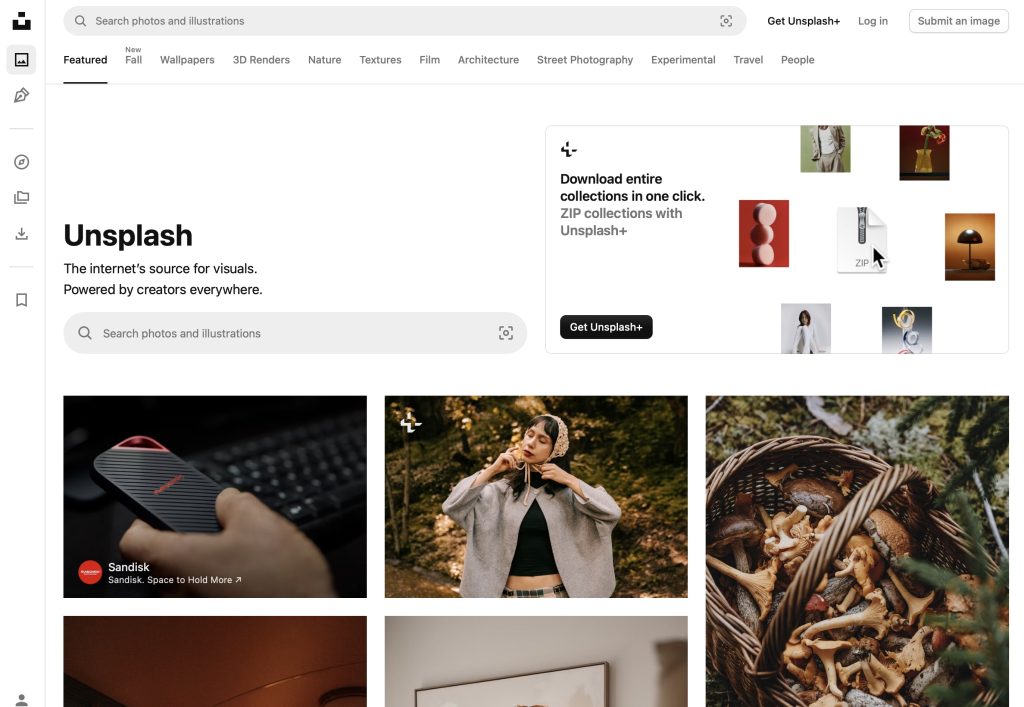
Unsplash remains the obvious first stop, and there’s a reason it became practically synonymous with free stock photography.
Its enormous library covers everything from architecture and landscapes to portraits, technology, food, interiors, and abstract textures. More importantly for designers, much of the photography feels editorial rather than traditionally “stock.” You’ll find cinematic lighting, interesting compositions, negative space for typography, and plenty of images capable of carrying an entire hero section.
Images covered by the Unsplash License can generally be used for commercial projects without attribution, although crediting photographers is encouraged.

Best for: Hero images, lifestyle photography, architecture, travel, editorial layouts, backgrounds.
Why designers should care: The search is excellent and the sheer size of the library means you can usually find something usable within minutes.
And here’s something particularly useful in the age of AI: Unsplash currently says it does not accept generative-AI content. Its submission rules prohibit images created using generative AI, making it one of the more straightforward large libraries when you’re specifically looking for human-created photography.
Watch out: The Unsplash License doesn’t magically clear every right attached to what’s pictured. Recognizable people, trademarks, artwork, and some properties can still require additional permissions depending on how you use the photograph.
2. Pexels

Pexels is probably Unsplash’s closest competitor—and depending on what you’re searching for, occasionally the better one.
It has a huge collection covering people, business, technology, interiors, cities, nature, fashion, and just about every other category imaginable. It also has an excellent collection of free stock video, making it especially valuable for designers working on animated hero sections, social content, presentations, or motion-heavy websites.
Pexels allows its photos and videos to be used commercially, attribution isn’t required, and assets can be modified.
Best for: Websites, campaigns, social media, presentations, video backgrounds.

Why designers should care: Having photography and video under one roof can dramatically speed up projects requiring a consistent visual direction across formats.
Better still for this list, Pexels explicitly prohibits contributors from uploading generative-AI photos and videos. At a time when distinguishing photography from generated imagery is getting increasingly difficult, that’s a surprisingly meaningful feature.
Watch out: You can’t simply sell unmodified Pexels images as standalone stock, and recognizable people, logos, brands, and artwork can involve rights beyond the photographer’s copyright.
3. Pixabay
Pixabay is the Swiss Army knife of free media sites.
While Unsplash and Pexels built their reputations primarily around photography, Pixabay contains photos, illustrations, vectors, video, GIFs, music, sound effects, and other media. That makes it especially useful when a project suddenly requires an icon, background illustration, or looping video five minutes before delivery.
Its Content License permits broad commercial use and modification, subject to restrictions such as selling content on a standalone basis.
Best for: Mixed-media projects, illustrations, backgrounds, vectors, video, presentations.
Why designers should care: You can potentially source several different types of assets without bouncing between six websites.
AI warning: Unlike Unsplash and Pexels, Pixabay accepts AI-generated content and has guidelines specifically covering it. So if human-made imagery is the goal, check the individual asset and contributor rather than assuming everything was captured through a lens.
4. Kaboompics
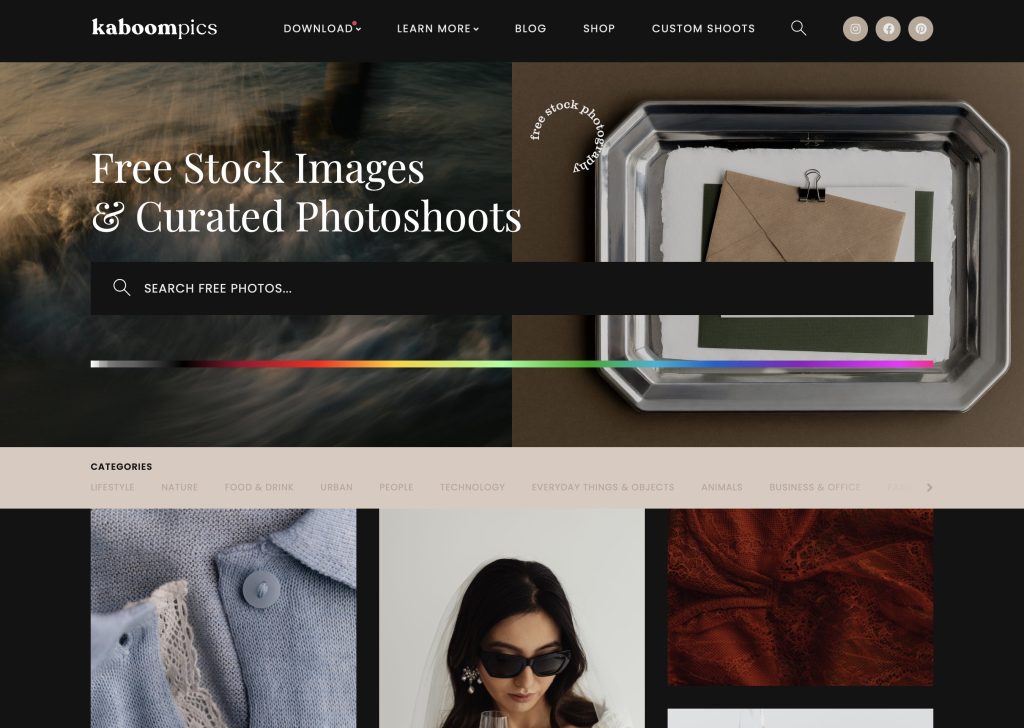
Kaboompics is one of those resources that makes you wonder why it isn’t mentioned more often.
Created by photographer Karolina Grabowska, it has a particularly strong collection of interiors, lifestyle, fashion, beauty, food, and aesthetically styled scenes. The big advantage is that many images come from coordinated photoshoots rather than unrelated contributors.
That means you can often find several photographs of the same scene, model, or environment from different angles.
Best for: Branding, fashion, beauty, interiors, editorial layouts, social campaigns.
Why designers should care: Visual consistency. Instead of stitching together five photographs with completely different lighting and color temperatures, you can build a page from one coherent shoot.
Even better, Kaboompics explicitly says its photographs come from real photoshoots and aren’t AI-generated. It also provides complementary color palettes for images, which is the kind of detail that suggests somebody remembered designers would actually be using these things.
Watch out: Check individual licensing information, particularly if an image is identified for editorial rather than broader commercial use.
5. StockSnap
StockSnap takes a refreshingly straightforward approach to free photography.
Its library includes business, nature, people, food, travel, technology, and abstract imagery, with photographs released under CC0. That gives designers broad copyright permission to copy, modify, and use images commercially without attribution.
The interface is also relatively uncluttered, making StockSnap a good second search when the giant libraries are producing too much noise.
Best for: Business websites, technology, nature, lifestyle, backgrounds.
Why designers should care: CC0 is about as painless as copyright licensing gets, and there’s a decent selection of images with enough negative space for headlines and interface elements.
Simple. Free. Photographic. Sometimes that’s precisely what you need.
6. Burst by Shopify
Burst was created by Shopify with businesses and entrepreneurs in mind, and that commercial DNA shows.
Instead of focusing exclusively on artistic landscapes and impossibly attractive people wandering through Iceland, Burst has imagery around products, retail, entrepreneurs, workplaces, fashion, fitness, food, and e-commerce.
That makes it particularly useful when you’re designing something that actually needs to sell something.
Best for: E-commerce stores, startup sites, product categories, marketing campaigns, small businesses.
Why designers should care: The photography often anticipates real commercial layouts. You’ll find images that work naturally as category banners, website headers, marketing backgrounds, and product-related content.
It’s stock photography that occasionally remembers the website needs to convert.
7. picjumbo
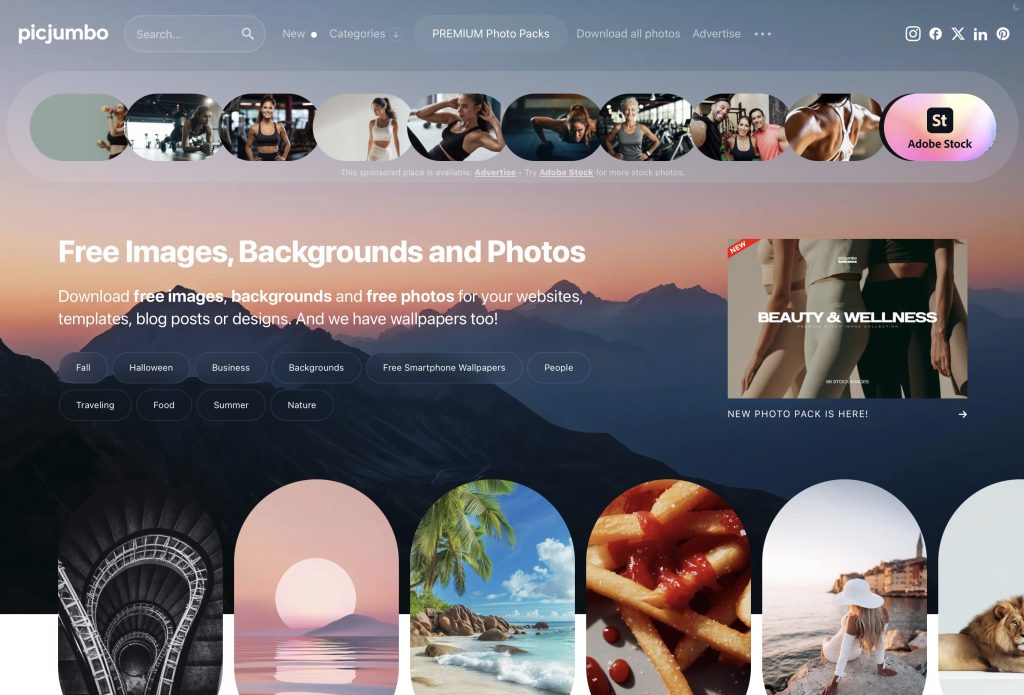
picjumbo has one of the better origin stories in stock photography.
Designer and photographer Viktor Hanacek launched the site after stock agencies rejected his photographs for “lack of quality.” Millions of downloads later, that assessment has aged about as well as you’d expect.
The collection includes business, technology, food, fashion, people, nature, and lifestyle photography, with free images available for commercial projects, including client work.
Best for: Web design, blogs, app mockups, marketing, lifestyle brands.
Why designers should care: Because much of the library comes from a recognizable photographic voice, it often feels less like an anonymous stock warehouse and more like browsing a photographer’s portfolio.
There are premium options too, but the free collection is substantial enough to deserve a bookmark.
Watch out: picjumbo notes that some images may not have model or property releases. That’s particularly important for advertising and other uses involving recognizable people, brands, or properties.
8. NegativeSpace
NegativeSpace offers high-resolution photography across categories including architecture, technology, people, nature, objects, and workspaces.
The collection is smaller than the major stock giants, but that’s not necessarily a disadvantage. Searching Unsplash for something like “office” can feel like being asked to choose one grain of sand from an entire beach.
Smaller collections can be faster.
Best for: Architecture, objects, technology, workspaces, abstract backgrounds.
Why designers should care: NegativeSpace makes its photographs available under CC0, giving designers broad freedom to use and adapt them commercially without attribution.
It’s particularly useful as a secondary source when you’ve started seeing the same familiar stock images everywhere else.
And finding a photograph that hasn’t already appeared on 38 SaaS landing pages is increasingly a design feature in itself.
9. Life of Pix
Life of Pix is a photography-focused library featuring high-resolution work from photographers around the world.
The collection leans toward expressive, editorial-style photography rather than aggressively optimized commercial stock. You’ll find architecture, landscapes, street photography, food, textures, objects, and unusual compositions.
Best for: Editorial layouts, architecture, travel, food, atmospheric hero imagery.
Why designers should care: Life of Pix is useful when you want a photograph to establish a mood rather than merely illustrate the noun in your headline.
It feels more like browsing photography and less like searching a database for “businesswoman pointing upward.”
As with any free-stock source, check the current license and any restrictions associated with the image before using it in higher-risk commercial applications.
10. Gratisography
Gratisography has spent years doing almost the exact opposite of conventional stock photography.
Photographer Ryan McGuire built the collection around strange poses, exaggerated expressions, surreal concepts, bright colors, and images with actual personality.
If your search for “business meeting” keeps producing eight people applauding a pie chart, Gratisography may be the antidote.
Best for: Humorous campaigns, editorial graphics, unconventional brands, social media.
Why designers should care: Weird is useful. In a world where enormous image libraries are converging on the same polished visual language, intentionally odd photography can make a design instantly more memorable.
Gratisography permits commercial use under its license, subject to its restrictions.
Not every client will approve.
That’s partly the point.
11. Public Domain Pictures
Public Domain Pictures is less polished than most modern stock sites, but that’s also why it’s useful.
The collection contains a sprawling mixture of photography, illustrations, textures, backgrounds, historical material, and other images contributed over many years. Much of the site’s material is presented as public domain, making it useful when you need something more specific—or simply less familiar—than what the fashionable stock libraries keep returning.
Best for: Backgrounds, textures, nature, objects, illustrations, unusual subjects.
Why designers should care: It has the chaotic charm of the older web. You may have to dig, but that digging can surface images that haven’t been optimized into the same aesthetic as every contemporary stock collection.
Watch out: Check the information attached to the individual image. Public-domain copyright status doesn’t automatically resolve model releases, trademarks, property rights, or other third-party restrictions.
12. ISO Republic
ISO Republic offers free photography and video across popular categories such as technology, business, architecture, food, nature, and people.
The collection is straightforward and practical, which makes it particularly useful for everyday production work rather than endless inspiration browsing.
Its imagery is offered under CC0, allowing commercial use without attribution.
Best for: Websites, blogs, presentations, backgrounds, commercial marketing.
Why designers should care: Sometimes you don’t need a revolutionary photograph.
You need a good photograph of a desk by 4 PM.
ISO Republic is exactly the kind of secondary library worth keeping around for those searches.
13. Skitterphoto
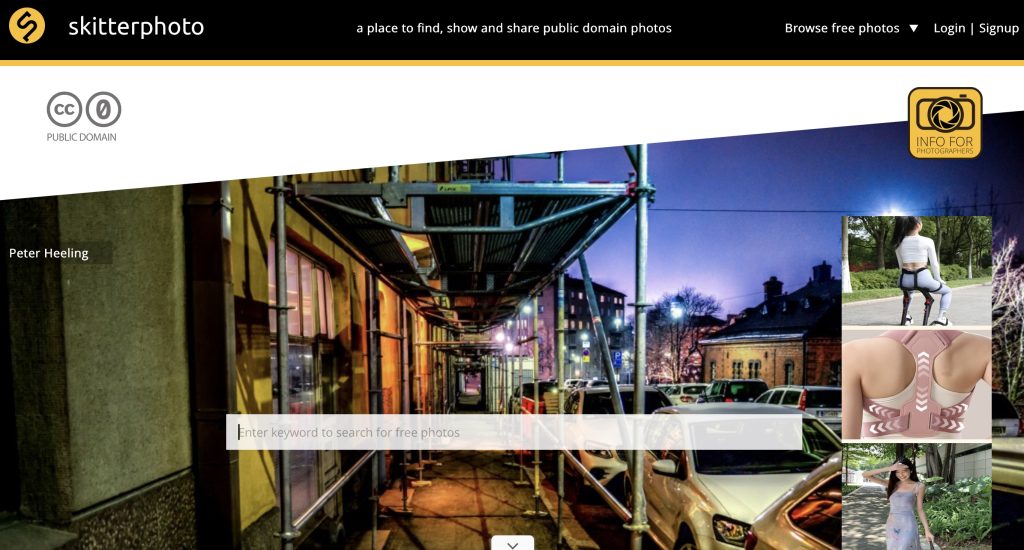
Skitterphoto was created by photographers and built around freely usable photography.
Its collection covers nature, architecture, people, animals, transportation, objects, travel, and plenty of scenes that don’t necessarily feel engineered around stock-photo keywords.
Images are published under CC0, providing broad commercial reuse rights without mandatory attribution.
Best for: Nature, cities, everyday objects, travel, editorial design.
Why designers should care: The site’s photographic roots make it an appealing place to hunt for images that retain a little more of the photographer’s personality.
When you’re specifically trying to escape the increasingly synthetic look of online imagery, that imperfection can be exactly what you’re looking for.
14. Foodiesfeed
Foodiesfeed solves one problem extremely well: food.
You’ll find ingredients, restaurant dishes, coffee, desserts, cooking scenes, healthy food, fast food, and all the beautifully lit carbohydrates your layout can handle.
For designers working on restaurant sites, recipe projects, delivery apps, food blogs, or packaging mockups, a specialist library can produce far better results than searching a generic stock site.
Best for: Restaurants, menus, delivery apps, recipes, food brands, hospitality.
Why designers should care: Food photography is difficult to fake convincingly—and bad food photography can make a perfectly good restaurant look like a crime scene.
AI warning: Foodiesfeed contains AI-generated imagery as well as conventional photography. If authentic human-made photography is specifically required, check the individual image before downloading it.
15. New Old Stock
New Old Stock is where this list starts becoming much more interesting.
Rather than contemporary stock photography, it curates vintage photographs from public archives and material presented as having no known copyright restrictions.
The result is an extraordinary mixture of old cities, transportation, workplaces, people, industrial scenes, travel, and everyday life.
Best for: Retro branding, editorial design, historical projects, collage, moodboards.
Why designers should care: Historical photography gives designs instant texture and character. It also avoids one increasingly common problem with modern stock: everything looking suspiciously like everything else.
Nobody in these photographs is pretending to brainstorm around a laptop.
Mostly because the laptop hasn’t been invented yet.
Important: Don’t treat New Old Stock itself as automatic commercial clearance. The site advises users to follow through to the originating institution and check its rights statement when determining whether commercial use is permitted. Think of it as an excellent discovery tool for historical imagery, then verify the individual source.
16. Rawpixel Public Domain
Rawpixel’s Public Domain collection is a treasure chest for designers who think beyond photography.
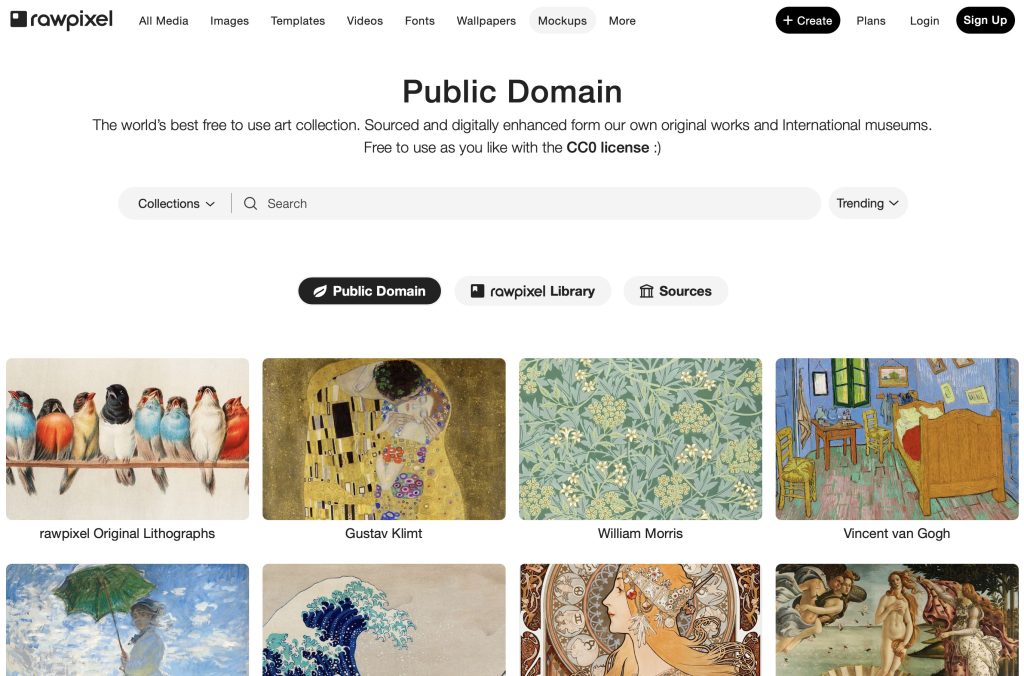
The important words here are Public Domain collection. Rawpixel itself contains other types of content—including AI imagery—but this specific collection brings together public-domain material from museums, libraries, and historical archives.
You’ll find botanical illustrations, paintings, engravings, Japanese prints, scientific drawings, maps, decorative motifs, vintage advertisements, and much more.
Best for: Collage, packaging, editorial design, posters, branding, vintage aesthetics.
Why designers should care: These assets can become ingredients rather than finished images. Crop them, isolate elements, combine several pieces, add typography, recolor them, or use tiny fragments as textures.
Before asking an image generator for “an authentic 19th-century botanical engraving,” remember that the 19th century already made quite a lot of them.
17. The Met Open Access
The Metropolitan Museum of Art has made hundreds of thousands of images of public-domain artworks available through its Open Access initiative.
And “artworks” barely describes the range involved. Paintings, sculpture, armor, textiles, furniture, photography, manuscripts, ceramics, jewelry, musical instruments, and objects spanning thousands of years are searchable.
Look for objects identified as Public Domain/Open Access rather than assuming every image on the museum’s website has identical rights.
Best for: Fine art, editorial layouts, cultural projects, patterns, textures, collage.
Why designers should care: This isn’t a stock library created to anticipate what marketers might search for. It’s human visual culture stretching across civilizations.
That unpredictability is precisely what makes it useful.
A 2,000-year-old decorative motif may provide a more interesting starting point for your next identity project than page 19 of “abstract gradient background.”
18. Rijksmuseum
The Rijksmuseum in Amsterdam has been remarkably progressive about making its collection accessible digitally.
Its online resources include high-quality reproductions of paintings, drawings, prints, historical objects, decorative arts, and photography, including masterpieces by Rembrandt and Vermeer.
But don’t just search the famous names. The real design gold can be hidden in old book illustrations, ornamental objects, textiles, engravings, and tiny details buried inside paintings.
Best for: Fine art, textures, historical imagery, editorial design, collage.
Why designers should care: High-resolution museum imagery can be cropped aggressively. A tiny corner of a 17th-century painting can become an extraordinary full-screen texture or background.
A large amount of the Rijksmuseum’s digitized public-domain material is available for reuse, but check the copyright or rights statement attached to the individual object rather than assuming every image in the entire collection is unrestricted.
Rembrandt probably never expected his work to appear behind a newsletter signup form.
Design evolves.
19. Smithsonian Open Access
Smithsonian Open Access is almost absurdly large.
Millions of digital items from Smithsonian museums, libraries, archives, research centers, and other collections are available, with millions designated CC0.
That means photographs, scientific specimens, historical objects, artworks, aircraft, animals, inventions, documents, clothing, cultural artifacts, and things sufficiently strange that no conventional stock photographer would ever think to shoot them.
Best for: Science, history, nature, technology, editorial design, experimental projects.
Why designers should care: Specificity.
Generic stock photography is good at “person using computer.”
Smithsonian collections are good at “prototype flying machine from 1898.”
Guess which one readers are more likely to remember.
Look specifically for the CC0 designation when you want material from its Open Access program.
20. National Gallery of Art
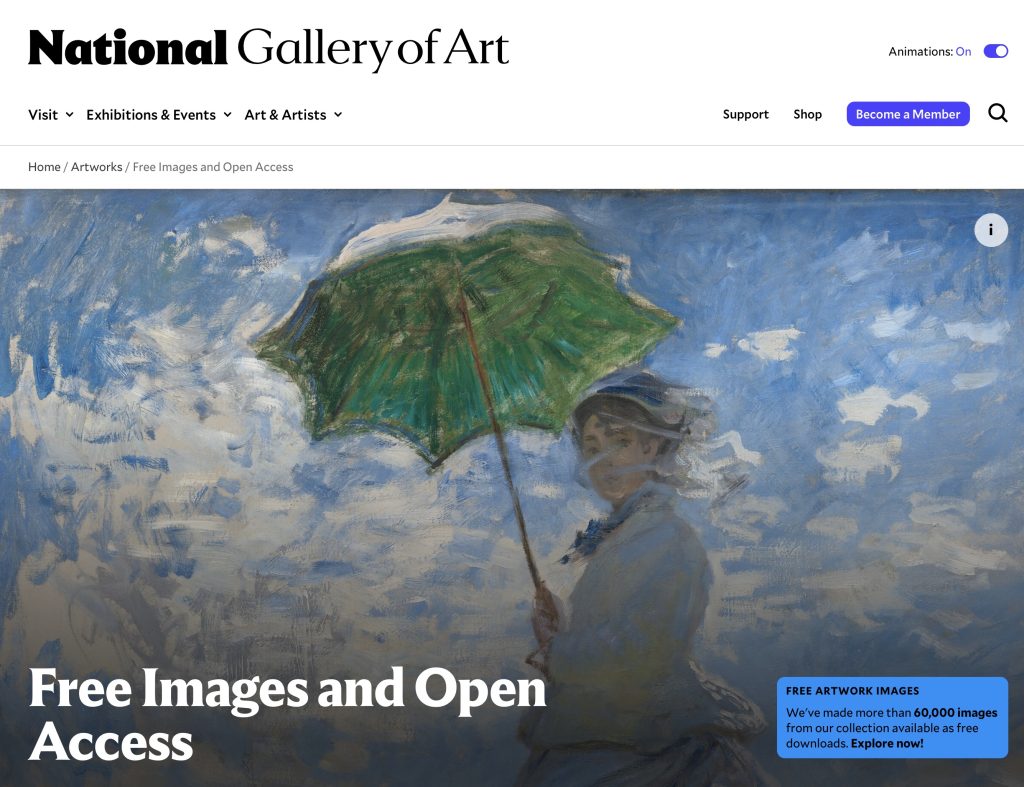
The National Gallery of Art provides tens of thousands of Open Access images of works it believes to be in the public domain, available for commercial and non-commercial use.
The collection includes paintings, drawings, prints, photographs, sculpture, and decorative arts from centuries of art history.
High-resolution reproductions make the archive useful not merely for displaying entire paintings but for extracting details, textures, palettes, compositions, and visual references.
Best for: Editorial design, art projects, cultural content, backgrounds, moodboards.
Why designers should care: Fine art is an astonishingly underused source of design material considering how much of it is freely accessible.
Your client asked for something that feels sophisticated and premium?
Apparently, a Renaissance master fits the budget.
21. Library of Congress
The Library of Congress is one of the web’s great visual rabbit holes—but commercial-use rights need a little attention.
Its enormous collections contain historical photography, posters, maps, architectural drawings, advertisements, newspapers, manuscripts, illustrations, and documentation of everyday life across generations.
The easiest starting point is its Free to Use and Reuse portal, which groups material the Library believes is public domain, has no known copyright, or has been cleared for public use.
Best for: Editorial design, history, collage, maps, Americana, research-heavy projects.
Why designers should care: Search specificity is the superpower. You can find imagery no conventional stock library would have any commercial reason to maintain.
Watch out: Don’t assume everything on the entire Library of Congress website is commercially unrestricted. For material outside its Free to Use and Reuse collections, check the individual Rights & Access statement.
22. NASA Image and Video Library
NASA’s Image and Video Library may have the highest production value of any free image resource on Earth.
Technically, some of it wasn’t even photographed on Earth.
Search missions, planets, astronauts, rockets, satellites, Earth observation, the Moon, nebulae, spacecraft, mission control, and decades of space exploration.
Best for: Editorial and informational projects involving science, technology, space, history, and futuristic interfaces.
Why designers should care: NASA imagery is genuinely difficult to replicate because NASA has access to a rather exclusive photography studio called space.
And because so much of the imagery documents real missions and real objects, it has an authenticity that even spectacular generated space art doesn’t possess.
Watch out: Don’t translate “NASA imagery is often reusable” into “NASA says I can do absolutely anything with everything on its website.” NASA has specific media guidelines, particularly around advertising and promotional uses, its protected insignia and logos, identifiable people and employees, implied endorsement, and third-party copyrighted material.
For commercial advertising, merchandise, or promotional use, check NASA’s current media guidelines before proceeding.
23. Wikimedia Commons
Wikimedia Commons is simultaneously one of the most useful and least glamorous websites a designer can bookmark.
It contains tens of millions of photographs, illustrations, maps, diagrams, artworks, flags, historical images, scientific material, and media covering almost every conceivable subject.
Need a photograph of a specific railway station in Romania? A medieval astronomical diagram? A 1920s vacuum cleaner?
There’s a decent chance somebody uploaded it.
Best for: Places, history, obscure objects, science, diagrams, editorial content.
Why designers should care: Wikimedia Commons excels precisely where commercial stock fails: subjects too specific, old, obscure, academic, or unprofitable for a stock photographer to care about.
The catch: There isn’t one universal Wikimedia license. Every file has its own licensing information. Public-domain and CC0 files are usually simplest; CC BY requires attribution, while CC BY-SA adds share-alike requirements.
Read the file page before using the image.
Yes, we know. Reading again.
24. Openverse
Openverse isn’t really another image library.
It’s a search engine for openly licensed media, which potentially makes it more powerful than many individual sources on this list.
Instead of limiting yourself to one archive, Openverse searches Creative Commons and openly licensed material from numerous sources. Filters can help narrow results by license and commercial-use permissions.
Best for: Highly specific subjects, Creative Commons photography, research, unusual imagery.
Why designers should care: Openverse is what you use when searching the big stock libraries for 20 minutes has produced absolutely nothing useful.
It expands the search beyond conventional stock and into the enormous ecosystem of openly licensed photography, museum material, archives, and other collections.
Watch out: Treat Openverse as the discovery layer, not the final licensing authority. Openverse itself recommends verifying licensing information. Follow the result to its original source and check the current license before using it commercially.
25. Flickr Creative Commons
Yes, Flickr still exists.
More importantly, its age has accidentally become one of its greatest advantages.
Flickr contains an enormous photographic archive created over decades, including vast amounts of material uploaded long before generative AI existed. You’ll find travel photography, street scenes, events, architecture, hobbies, communities, technology, nature, and the wonderfully mundane details of everyday life.
Filter for Creative Commons licenses that allow commercial use, such as CC BY or CC BY-SA, and it becomes an extremely powerful source.
Best for: Travel, cities, events, street photography, niche subjects, authentic everyday imagery.
Why designers should care: Flickr photographs frequently look like photographs, rather than stock photography.
They’re sometimes imperfectly composed. Lighting isn’t always immaculate. Random people wander into the background. Things look used. Cities look messy.
In 2026, those imperfections can feel surprisingly refreshing.
Watch out: Flickr hosts images under many different licenses. Check each photograph individually and follow its attribution and other licensing requirements.
The Secret Weapon: Search Backwards
If your goal is specifically to find human-made imagery, there’s an extremely simple technique:
Search the past.
A photograph uploaded to Flickr in 2009 wasn’t generated by Midjourney. A museum scan of an 1887 botanical illustration wasn’t created by Stable Diffusion. A NASA photograph from Apollo 11 didn’t begin with somebody typing “cinematic astronaut, dramatic lighting, ultra detailed, 8K.”
Older Creative Commons collections, historical archives, digitized museum collections, and established photography libraries contain an enormous reservoir of unquestionably human-created imagery.
And there’s another advantage.
It’s often more visually interesting.
Contemporary stock photography has become extraordinarily polished. So has AI imagery. Both can converge toward the same immaculate lighting, perfect composition, flawless skin, carefully curated interiors, and suspiciously photogenic bowls of salad.
Historical and documentary imagery wasn’t created to satisfy today’s visual algorithms.
That’s exactly why it can make a design feel different.
Don’t Use the Image. Use Part of the Image.
Museum and archival resources become particularly interesting when designers stop treating them as finished photographs.
Download a high-resolution public-domain painting and look at it at 400%.
Suddenly you have:
- textures from cracked paint;
- unexpected color palettes;
- tiny architectural details;
- fabric patterns;
- ornamental borders;
- brushwork that becomes abstract at scale;
- strange compositions you’d never deliberately create.
A 500-year-old painting doesn’t have to sit politely inside a rectangular frame with the artist’s name underneath it.
It can become raw design material.
The same applies to maps, scientific diagrams, botanical illustrations, vintage advertisements, NASA imagery, and historical photography.
That’s where these archives can become dramatically more interesting than ordinary stock sites.
But Is It Really Free for Commercial Use?
Here’s the boring section that could potentially save you from a much more exciting email from a lawyer.
Copyright permission and commercial clearance aren’t always the same thing.
An image may be free to reproduce under CC0 or another permissive license while containing other protected elements.
A photograph might include a recognizable person with publicity or privacy rights. A building might contain protected artwork. A product could display a trademark. A photograph of an artwork could involve multiple layers of rights depending on the artwork, photograph, jurisdiction, and intended use.
This becomes particularly important when imagery is used in advertising, product packaging, merchandise, political campaigns, endorsements, sensitive subjects, or anything suggesting that a recognizable person supports a company or product.
For an editorial illustration accompanying a blog post, the risk profile can be very different from printing someone’s face across 50,000 shampoo bottles.
When the commercial stakes are high, check the individual asset and, where necessary, get appropriate legal guidance.
CC0, CC BY, CC BY-SA: What’s the Difference?
If you’re going beyond the big stock libraries, you’ll encounter Creative Commons licenses constantly.
The simplified designer version is:
CC0 — The copyright owner has waived copyright and related rights to the extent legally possible. It’s usually the easiest starting point for commercial design, but it doesn’t automatically clear trademarks, privacy or publicity rights, recognizable people, or other third-party rights.
CC BY — Commercial use is permitted, but you must provide appropriate attribution and comply with the license conditions.
CC BY-SA — Commercial use is permitted with attribution, but adaptations generally need to be distributed under the same license.
CC BY-NC — The NC means NonCommercial. Don’t use it for commercial work unless you separately obtain permission.
That’s deliberately simplified; Creative Commons licenses contain more detail than four lines in a design article can cover.
When in doubt, click the license.
One More Thing: Licenses Change
Don’t assume this article—or any stock-site roundup—is the final licensing authority forever. Websites change owners. Terms get rewritten. Collections are reorganized. Contributors upload material under different licenses. Platforms introduce AI content. Yesterday’s completely free library becomes tomorrow’s “start your seven-day trial.”
Before using an asset commercially, check the current license on the actual source. If the project matters, keeping a record of the applicable license and source information at the time you downloaded the image is also a sensible habit. It takes 20 seconds. Twenty seconds is considerably cheaper than legal correspondence.
The WDD Takeaway
AI has given designers something extraordinary: the ability to generate virtually any image they can describe. Strangely, that may make images we can’t perfectly control more valuable.
The crooked street photograph. The grainy image from 1974. The strangely cropped Flickr upload. The scratches on an old NASA photograph. The uneven ink in a botanical print. The cracked paint on a Renaissance portrait. The random person wandering into the background of somebody’s photograph from 2008.
These used to be imperfections. Now they’re evidence. Evidence that somebody stood somewhere, looked at something, decided it was worth recording, and pressed a shutter—or picked up a pencil, brush, engraving tool, or camera.
AI imagery isn’t going anywhere, nor should it.
But when everyone has access to an infinite supply of perfectly generated images, authenticity becomes a design material of its own.
And remarkably, there’s still an enormous amount of it available for free.
